What is this page?
Dost is not on this page; only physics is. Why we are here: on the other pages, physics words such as "entanglement", "decoherence" and "Bell number" come up, and when they are explained only in sentences they stay abstract. Here we calculated each of them ourselves with the plainest textbook model and put it into a figure, so that you can read the answer to "what is there?" on the physics side by seeing it.
What are we doing with Dost? Nothing: this page does not explain Dost's words, and it does not pair them with anything. It stands only to show what a phenomenon you meet on the physics side while reading Dost looks like. You do the side-by-side reading yourself (for that, see the Parallel reading desk).
There are ten calculations: the number of the Bell test, a qubit becoming classical when it touches its environment, the "whole pure, part mixed" state, interference and path information spending each other, the GHZ state, Grover search, an eavesdropper stepping in on BB84, the Hong–Ou–Mandel dip, the Aharonov–Bohm phase shift, and the Zeno effect.
These are textbook models, not new physics. We did the calculation with QuTiP, an open-source quantum simulation library [Johansson 2012]; the code sits on the research side and loads nothing onto the site. Every number in the figures comes from our own calculation; it is not an experimental result. For the experiments themselves, the relevant sources should be consulted.
Under each figure we write three things: what we calculated, what it shows, and what it does not show.
1. The number of the Bell test
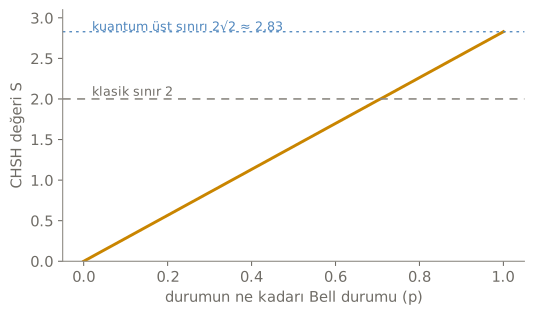
What did we calculate? We took the entangled "Bell state" of two qubits and calculated the CHSH number with four measurement directions [Clauser 1969]. Then we gradually mixed the state with noise.
What does it show? In any model that works with local, predetermined values, this number can be at most 2. Quantum theory gives 2√2 ≈ 2.83 for the fully entangled state; our calculation came out at 2.828. When about 71% (1/√2) of the state is the Bell state, the number drops below 2 and the correlation becomes explainable in a "classical" way.
What does it not show? It does not show the result of an experiment; in experiments this number was measured and exceeded 2 [Hensen 2015; Giustina 2015]. Nor is it a basis for saying "two distant things are a whole" or "everything is governed from a single consciousness": it only shows the exclusion of models with local hidden variables.
2. Becoming classical through contact with the environment
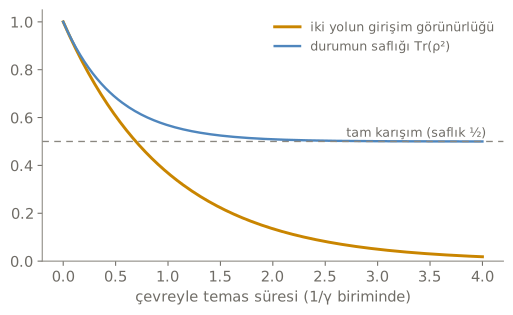
What did we calculate? We took a qubit in an equal mixture of two states (a superposition) and let it touch its environment weakly (pure dephasing, decay rate 1). We followed the interference visibility and the purity of the state over time.
What does it show? The term that carries the interference dies out exponentially: at time 1/γ the visibility is about 0.37 (our calculation: 0.368). Purity falls from 1 to 0.5; that is, the state approaches a classical mixture of the two options [Zurek 2003; Schlosshauer 2005]. The "classical-looking world" comes partly from here.
What does it not show? It does not explain which outcome occurs; it only shows why the interference disappears. It is not claimed to solve the whole measurement problem; the debate continues [Schlosshauer 2005].
3. The whole pure, the part mixed
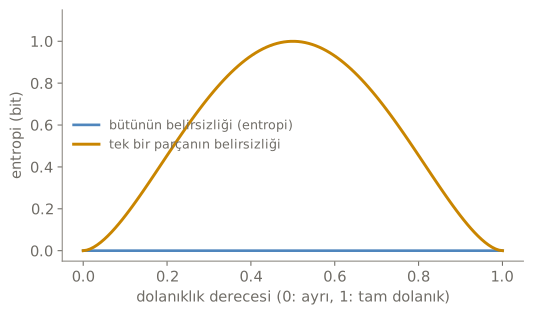
What did we calculate? We took an entangled two-qubit state whose degree can be adjusted. We calculated the uncertainty (entropy) of the whole and of just one part.
What does it show? The whole is always in a fully known "pure" state (entropy zero). But as entanglement grows, looking at just one of the parts the uncertainty grows, and at full entanglement it reaches 1 bit.
What does it not show? It does not say the part "cannot be described apart from the whole": the reduced state is perfectly well defined, only mixed. So this figure is not evidence for the "part–whole" closeness we set up on the form pages; it is a reminder for us to say it more carefully.
4. Visibility and path information
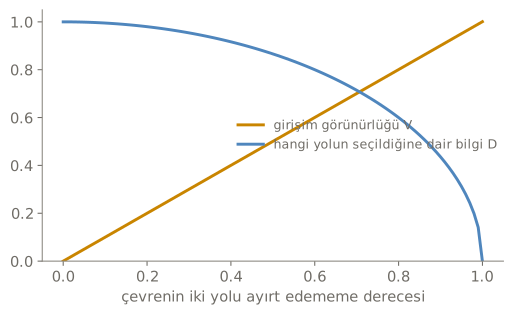
What did we calculate? We calculated how much interference remains depending on how distinguishable the trace a particle passing through two paths leaves on its environment is. For pure states, the square of the visibility plus the square of the path information comes out as 1 (numerical deviation at the 10⁻¹⁶ level) [Englert 1996].
What does it show? There is a trade-off between knowing which path was taken and seeing interference: as one rises, the other falls.
What does it not show? It also shows that the information does not need to be "known by an observer": the trace in the environment is enough. Reading it as "consciousness determines the outcome" would go beyond what this calculation can bear.
5. GHZ: a contradiction in three qubits with a single measurement
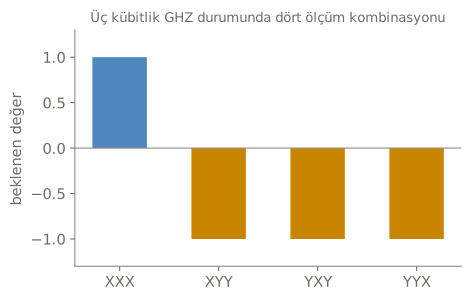
What did we calculate? We took the GHZ state of three qubits (an equal mixture of all-0 and all-1) [Greenberger 1989] and calculated the expected values of four measurement combinations: XXX, XYY, YXY, YYX. The values came out +1, −1, −1, −1. The sum we call the "Mermin number" comes to 4.000.
What does it show? In any model that works with local, predetermined values, this sum can be at most 2; quantum theory gives 4. The difference from the Bell test is this: here the difference is not a probability deviation but the definite values of four measurements contradicting each other together.
What does it not show? It does not show the result of an experiment; this is only the theoretical calculation of the state. Three-particle experiments have been done, but we do not read their results from this figure. It does not say "three things are a whole".
6. Grover: why the search speeds up this much
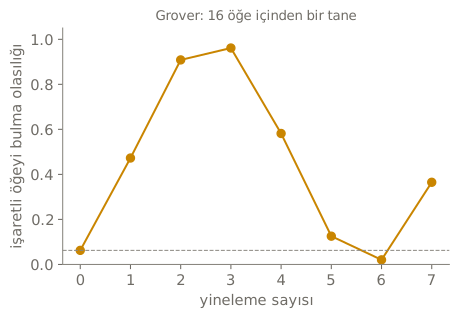
What did we calculate? We set up a search in which one of sixteen items is marked and applied Grover's two steps (flip the marked one, reflect about the mean) one after the other [Grover 1996]. The probability of finding the marked one starts at 0.063, rises to 0.961 at the third iteration, and falls to 0.582 at the fourth.
What does it show? The probability does not grow at every step; it climbs to a peak at a certain iteration and then falls. One has to stop at the right moment. With sixteen items the peak is at the third iteration; roughly the square root of N steps.
What does it not show? It does not say every search will speed up; the speed-up is specific to unstructured search of this kind. On a real computer, noise and circuit depth also enter the account.
7. BB84: stepping in leaves a trace
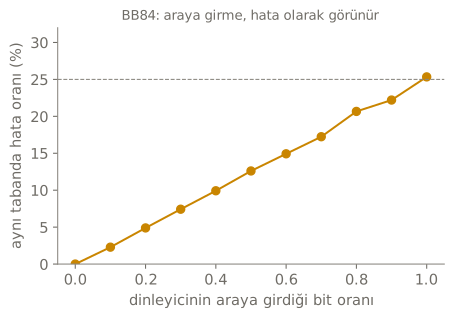
What did we calculate? We simulated on a computer a protocol in which the sender chooses a random bit and a random basis (one of two measurement directions) and the receiver measures with his own random basis [Bennett 1984]. An eavesdropper steps in, intercepts the bits, measures with her own random basis and resends. With forty thousand bits, we found that if the eavesdropper steps in on every bit, 25.3% of the bits chosen in the same basis come out wrong. If she never steps in, the error is zero.
What does it show? Every time the eavesdropper chooses the wrong basis, the bit becomes random; this appears as an error in the bits that sender and receiver later compare. The error rate grows linearly with the fraction of interception.
What does it not show? This is a simulation, not a measurement of a real channel. The noise, losses and attack types of real systems are outside this model. We also do not draw a conclusion such as "absolute security".
8. Hong–Ou–Mandel: two photons going to the same place
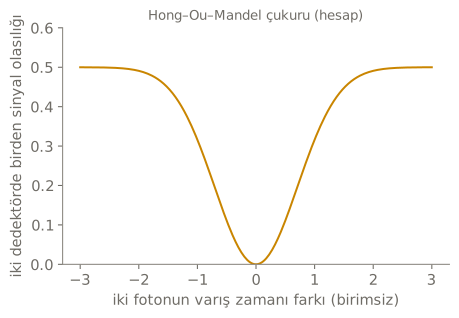
What did we calculate? We sent two photons to a half-transparent mirror (a 50:50 beam splitter) and calculated the probability of a signal arriving in two separate detectors at once [Hong 1987]. If the photons are fully distinguishable the probability is 0.500; if they are completely identical it is 0.000.
What does it show? When both paths are possible, the amplitudes cancel each other: the photons always leave together from the same output. As the time difference grows, the photons become distinguishable and the dip closes.
What does it not show? The shape of the wave packet is an assumption here (Gaussian); it does not give the dip width of a real experiment. Nor is it an experimental result.
9. Aharonov–Bohm: phase where there is no field
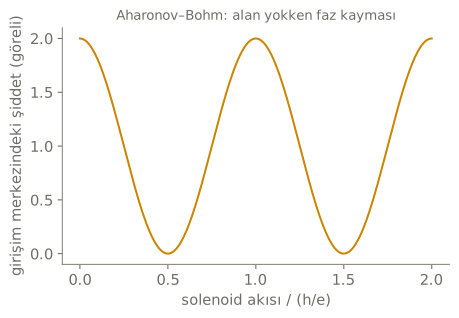
What did we calculate? An electron goes through two paths; we varied the flux of a small solenoid between the paths (a magnetic field inside, none outside) [Aharonov 1959]. We took the phase as the difference between the two paths and plotted the interference intensity. The flux equivalent of one full turn is h/e = 4.136 × 10⁻¹⁵ weber.
What does it show? Even though the electron goes through a region where there is no field, the pattern shifts because of the phase the vector potential gathers along the path.
What does it not show? This calculation does not give the conclusion "the potential is real"; that interpretation is disputed. The calculation shows only that the phase difference depends on the flux.
10. Zeno: looking often holds the state
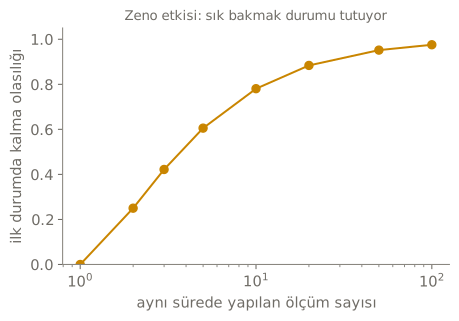
What did we calculate? For a two-level system that, if left alone, would pass completely from the initial state to the second state in a given time, we calculated the probability of remaining in the initial state if it is measured N times at equal intervals with the question "still in the initial state?" [Misra 1977]. With one measurement 0; with two measurements 0.250; with ten measurements 0.781; with a hundred measurements 0.976.
What does it show? As the number of measurements grows, the system stays in its initial state. This effect has also been seen in experiments [Itano 1990].
What does it not show? It does not settle the interpretation of the sentence "looking freezes the system": we can also calculate the measurement as an interaction of the system with its environment, and this does not settle the dispute over interpretation. Our calculation assumes ideal, instantaneous measurements.
What did we not do?
We did not make these figures a basis for the pairings on the form pages. They are only for seeing what the things on the physics side are. Source and code: research/kuantum/simulasyon/uret.py; to reproduce, QuTiP, NumPy and Matplotlib are needed.